How Condition Monitoring Cuts Your Energy Bill
The hidden cost of a sick motor
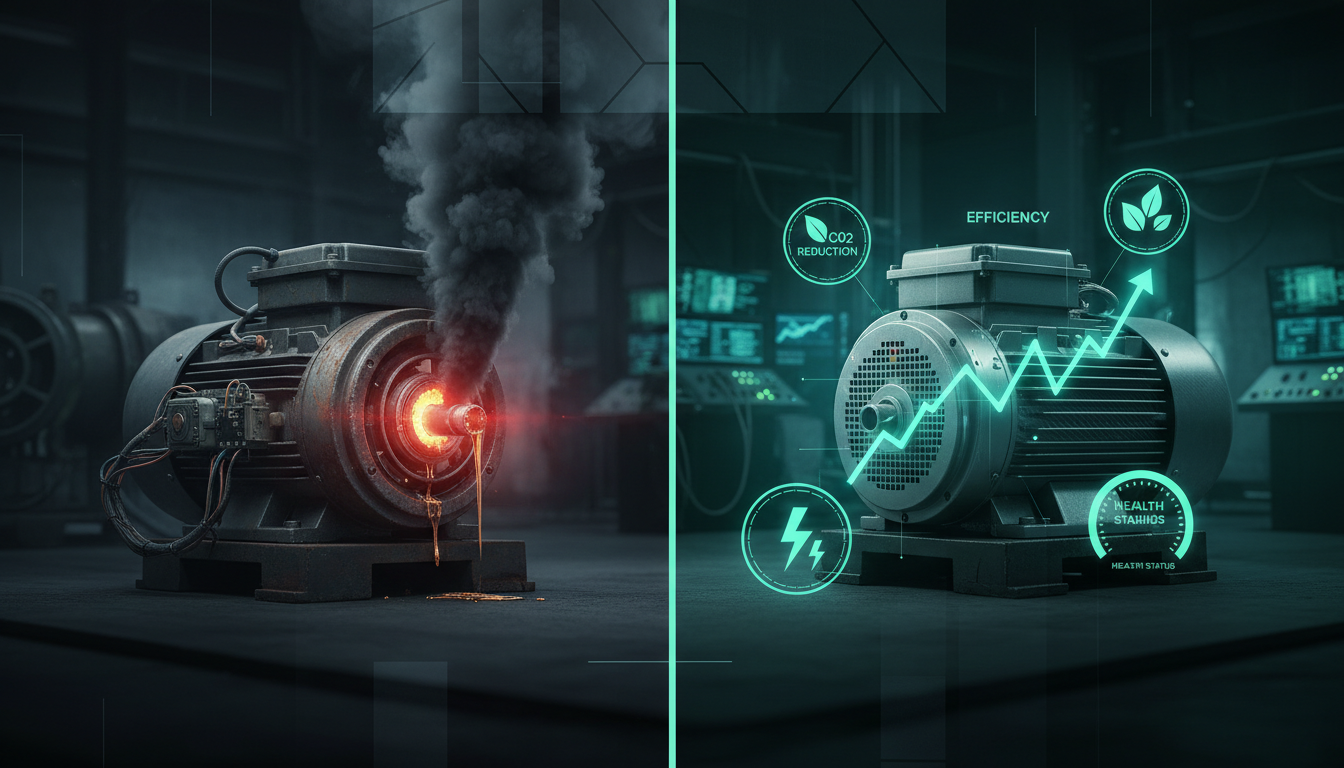
A motor approaching failure is rarely silent — it's just invisible without monitoring. As bearings wear, windings degrade, and alignment drifts, a motor draws more current and runs hotter. A failing motor can waste 10–12% more energy than a healthy one, and that waste runs 24/7 until the motor finally trips.
On a typical 15 kW industrial motor running 4,380 hours a year at £0.25/kWh, that's:
- Healthy motor: £16,425/yr in electricity
- Failing motor: £18,396/yr in electricity
- £1,971/yr wasted — per motor
Multiply that across a fleet of 20 motors and you're losing £39,000 a year to inefficiency you can't see.
What monitoring catches
Over-current
A motor drawing 10–20% above its baseline current is either overloaded or losing efficiency. Three-phase current monitoring flags this the day it starts — long before the motor trips.
Asymmetric current
When one phase draws more than the others, it's a signature of winding insulation degradation. The motor is still running, but it's burning itself out. Early detection means a rewind, not a replacement.
Temperature rise
A sustained 10°C rise above baseline means friction or overload. Heat kills insulation — every 10°C above rated temperature halves winding life. Catching a temperature rise early can extend a motor's life by years.
The CO₂ angle
Energy waste is also carbon waste. At the UK grid intensity of 0.233 kg CO₂/kWh, a single 15 kW motor wasting 12% of its consumption generates an extra ~1.8 tonnes of CO₂ a year. Across a fleet, condition monitoring becomes a measurable part of your sustainability reporting — not just a maintenance strategy.
How to quantify it
Our ROI calculator models the energy, downtime, maintenance, and CO₂ savings for your specific site based on your motor count, average rating, and current downtime. Most sites see the monitoring investment paid back within the first quarter, with net annual savings in the tens of thousands.
Book a free site survey to get a tailored energy-saving estimate for your facility.
See it in action on your site
Book a free site survey and we'll identify your highest-risk assets and model your ROI.